On efficiency, enthusiasm, and excellence. Notes from Travis Kalanick.

I spent the last couple of hours watching David Senra + Travis Kalanick. I want to say that I’d read some summary posts already, on X. But, it did NOT beat the experience of watching the episode. Because Travis is nerdy. David is a great host. And regardless of as many notes you read (including this one), you will pick something you find value in or relate to. So, I urge you watch the episode for yourself.
Now that you are here, some things that I will go back to often and shifted the shape of my neurons…
1/ If you think of problems like a math professor does, you’ll be okay.
A math professor is nobody without problems. If you are that person –
- Kalanick says – the derivative of problem solving must be greater than or equal to the derivative of problem creation. The cool thing I found – the only “challenge” he described in his current mission and business was – management capacity. He is limited by the number of people who can think like math professors and create problems to solve
- In two words – the people he described for “management capacity” – to be able to predict the nature of the problem. And then your ability to solve it. I think this was also interesting to see from the lens of young, ambitious people wondering – “what value can I add in the post AI world?”. It is THIS. And I think this ability is a function of many things. The other person to describe this well is Jensen.
2/ Super pumped
Kalanick talks about culture at Atoms and describes “super pumped” to be an infectious enthusiasm about hard things. The harder the problem, the more weird, gnarly and awesome it would be to solve it.
The distinction I found interesting? He said – super hard or super difficult doesn’t mean impossible. It is difficult, but it is not impossible. I should put this up on a wall. Because now – the lines are blurry in my head. When I think I cannot do something, I tag it as “difficult” and “impossible to do” both. But I am reminded of another thing Alex Hormozi said about winning. If you’re playing to win, then you will or actually ought to find a 100 ways to solve that problem. It is then, not impossible. But limited by your ability to try and think of those 100 ways.
He talks about Uber in China as the difficult but not impossible challenge. And how there was an excitement to think of different ways to solve it. And of course, a willingness to do it.
As I write this, I wonder – as Kalanick talks about Atoms now – has his definition of difficult changed or is just more pragmatic to know what’s difficult and still go at it to win?
Oh, a side note, Kalanick also talks about how the sparkle in his eyes for hard problems has been there since he was a child. I do believe some things are very very inherent to you as a person. And that’s why some people are cut out for great things and some are just not. I think I try to see and find which ones you can learn and internalise. Hunger and enthusiasm, for instance, cannot be taught. It can be unraveled if hidden deep inside, but it cannot be taught.
3/ Efficiency edge
Kalanick didn’t talk too much about competition. Or even if they did, not in the traditional sense of who did what better and who they were really competing with. But he spoke in frameworks. Talked about how they looked at the business.
One phrase / idea that stuck with me was efficiency edge. He seemed to describe a large part of Uber’s success and the working of Uber to be about building an efficiency edge. I’ve not been able to take the right notes to explain it myself. But that’s one reason why you must watch for yourself.
In short – you grow bigger faster depending on the efficiency edge you build.
4/ The extra fierceness that comes with being bothered and giving a shit
I’d read about this on X even before I watched the video. Maybe it’s been on my mind because one of my (actually my only) brain goal has been to become so zen that I am unbothered.
Kalanick says – there’s extra fierceness that comes with being bothered. And giving a shit. Warns us to be careful about embodying a lifestyle of adversity because the risk you run is how easy it can get to walk through it. In his words, you become so zen you’re unbothered.
And then, there’s the fierceness with calm on the inside. Kalanick says that’s where he is today.
I’ve been thinking about this. And I think, if I have a choice, I’d like to still embody the lifestyle of adversity. I also obviously want that extra fierceness. I know one must give a shit to create large things. But, I want to be a warrior in a garden. I want to stand on the edge, knowing I could tip to the side of unbothered zen. And choose to then give a fuck.
I don’t know about you. But something to think about for sure.
5/ Excellence is capacity to take pain.
David mentions this as a maxim he believes in. And Kalanick agrees. Also says – imagine a marathoner on his 21st mile. He’s not smiling. He is in pain. Because if he wasn’t feeling pain, someone else would be. The push of humans towards excellence is the push towards pain.
For me – this seems to outweigh even the most sensible debates about “balance” or “how much is too much”. I think it is either or. You either choose excellence for yourself or you don’t. I have not heard one person say or live the life of everything-at-once and build something large. Or make human race progress. They lived in seasons as Aporia defines it or as Naval says. Oh, also, think Whiplash.
A few weeks ago, I had the faint feeling that I’d begun to make excuses to myself. And I couldn’t figure if I was thinking of long-term sustainable health or simply making excuses. Here’s the answer. SG shared this with me. I do not have the source. Make of it what you will.
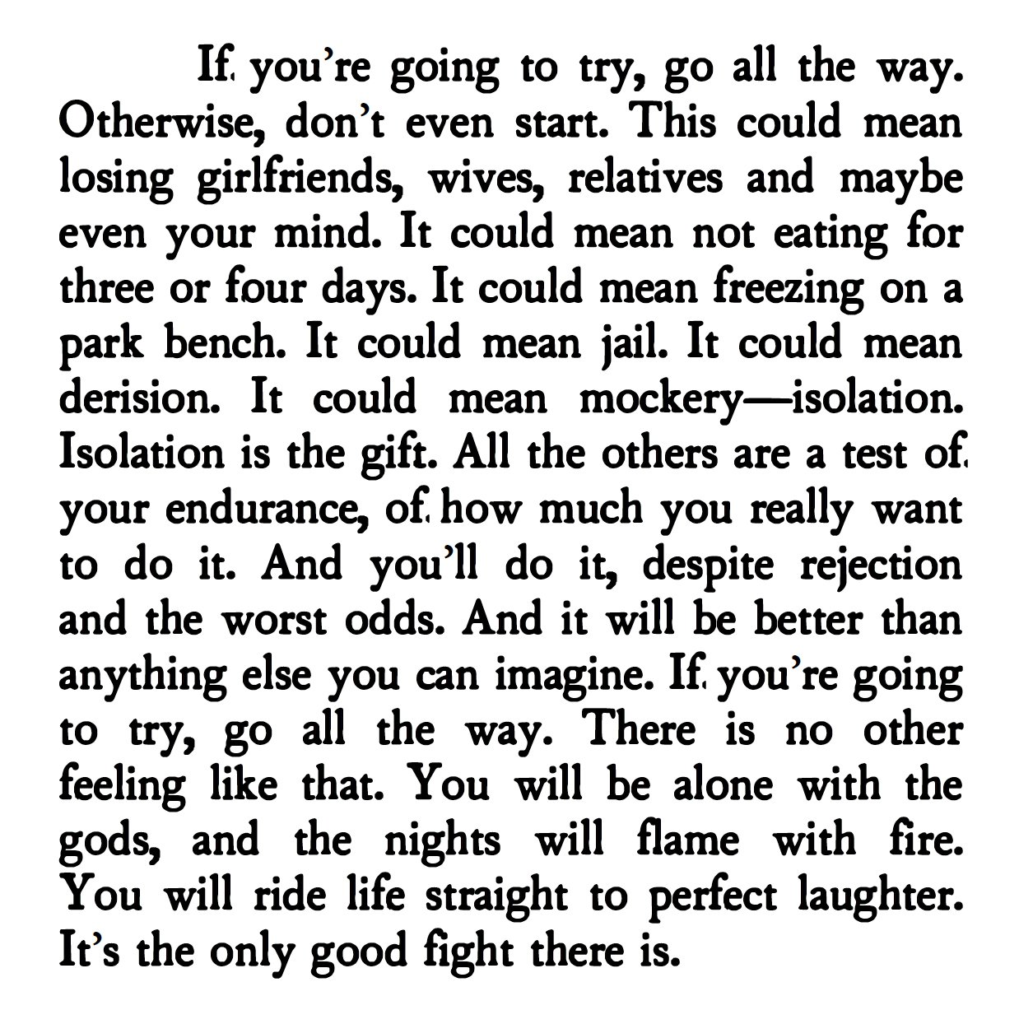
6/ Kalanick ran Uber as someone who thought he would be broke next week.
A 70 billion dollar company. Kalanick says he ran it as someone who thought he was going to starve next week. Not have money to pay for grocery bills. He carried that feeling in his core from his previous startup.
SG tells me this often. And even Gulshan sir told me this just recently. People who do not have a desperate desire or the hunger to do more, will not do more. Or, in Hindi, they’d say “bhara pet mehnat nahi karta“.
Kalanick perhaps did what he did, with such force, because he was playing to win. Gave himself and others no choice.
Makes me wonder if I am comfortable. That if I was not, would I try even harder to shrink time? And do more? If you know me, tell me? I don’t want to live in blind spots.
7/ You will never be truly world class if you have a fear of failure.
Kalanick says – fear creates blockage around making progress. The psyche around fear of failure fucks with your ability to get there. I have nothing to add here. Perhaps the most important note to self. My default state, I am learning, is fearful. And I am optimistic that with some rewiring and a lot of action, I can change it 😀
8/ A cool thing about him and young people
Two phrases. Alignment up front and accountability in the backend. He described his management with teams (especially young people) to be this.
They’d align on what they’re doing. How they will get there. The risks they run. The no-brainer things they will do. And then, create an environment that rewards accountability.
The example he gave was – taking Uber to new cities. There was some sort of a playbook. But mostly you’re going to make something out of nothing.
The alignment existed. And then, it was accountability. The 23-year-olds would go and figure out the undefined. And come back for the pricing call. If they didn’t make it, that sucks. But they did give it their all because they wanted to win.
He also talked about the management style as – you’re the problem solver and chief of your area. It tells me – high accountability too. And goes back to point one.
That was all. Here’s the video: https://youtu.be/QVnU5lGlKE8. If you watch it, send me your highlights?
P.S. Some keywords I will leave you with. That link to what I found cool. If you watch the video, tell me if you spotted / took note of the same things?
A. Order and chaos. An entrepreneur’s job to find the fine middle.
B. Fewest number of rules while staying out of chaos – the sweet spot.
C. China and Uber. New York and Uber.
D. Western entrepreneurs who succeed in Chins
E. In China – stability and progress to be in harmony
F. Kalanick on Capitalism and Anti-capitalism
P.P.S. I sat down to write about something like this after a while. And truly enjoyed it. Made me think hard. And I think this is how I’d like to be spending my IRL time too. Around people who make me think hard. And show me more of life!